Summary
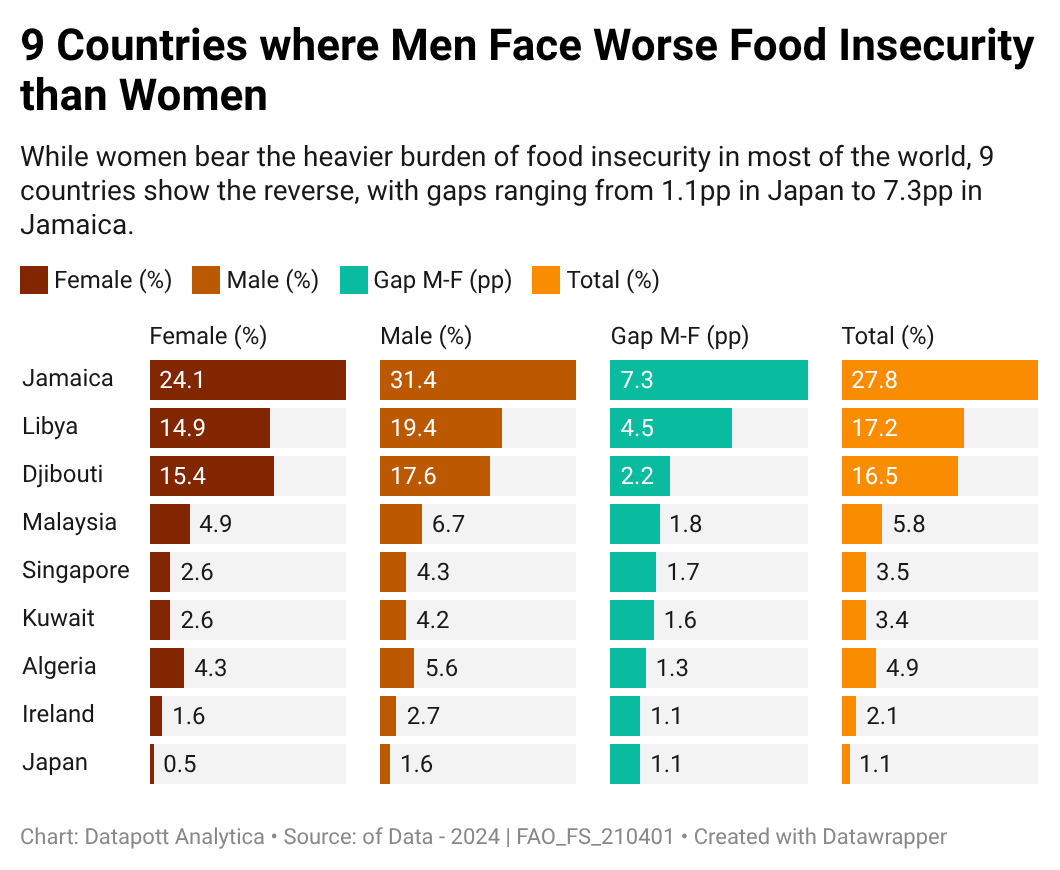
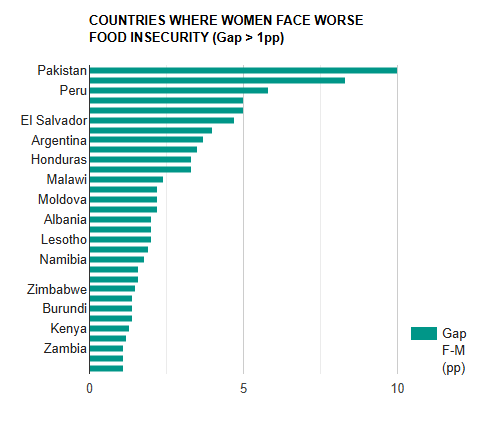
- In 31 of 125 countries assessed, women face severe food insecurity at significantly higher rates than men. This representing nearly 1 in 4 countries with gender-disaggregated food security data in 2024.
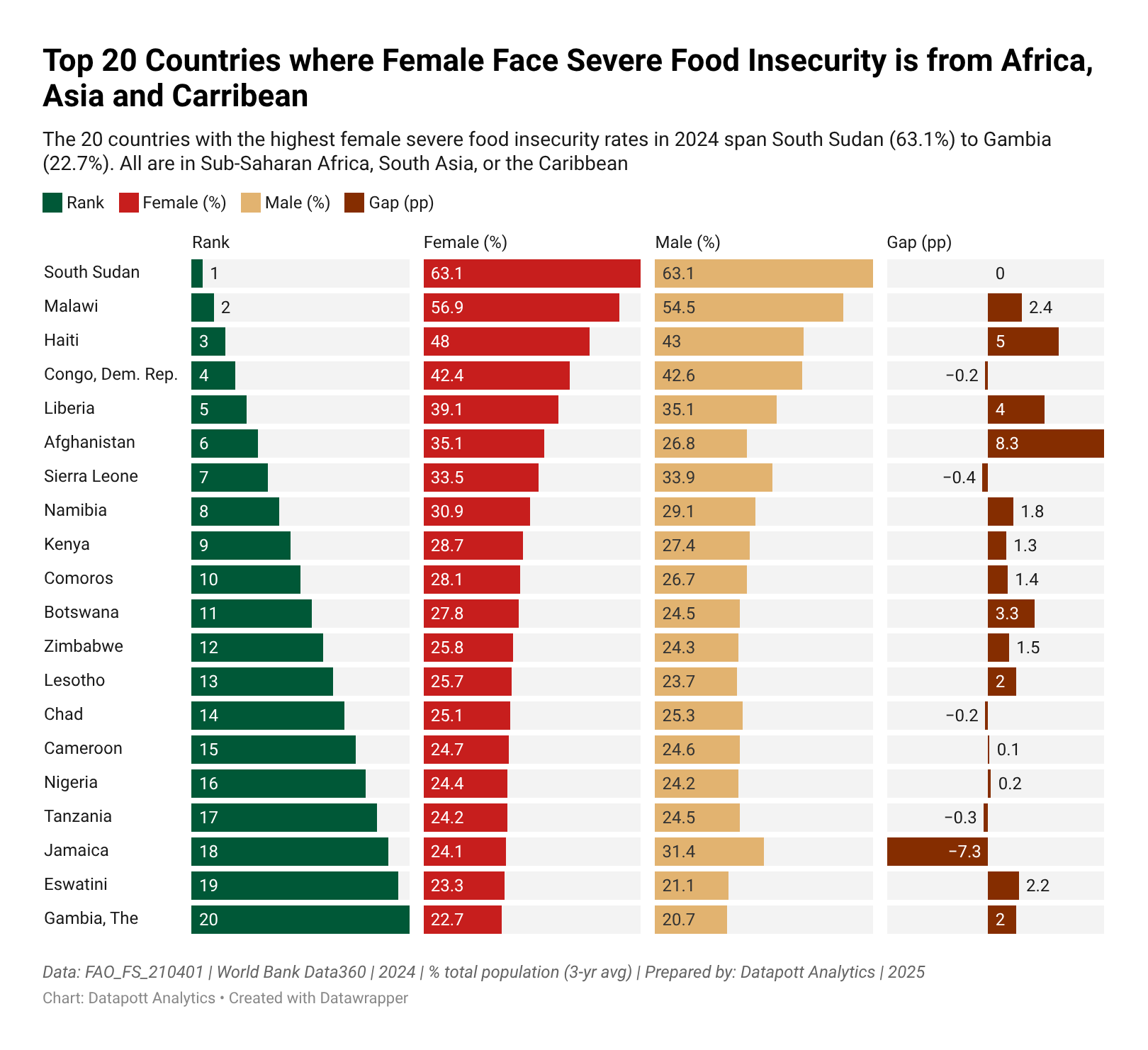
- The largest gender gaps are found in Pakistan (+10pp), Afghanistan (+8.3pp), and Peru (+5.8pp), all contexts where women’s economic participation and land rights are severely restricted by law, culture, or active conflict.
- The global mean gender gap has remained a persistent +0.63pp (Female minus Male) every year from 2016 to 2024. It is a stubborn, structural disadvantage that has not narrowed despite overall improvements in global food security rates.
- Sub-Saharan African and Latin American countries dominate the high-gap list, but the pattern is not regional — it is ideological: gaps appear in countries across all income levels where gender inequality in property, employment, or social norms remains unaddressed.
- Haiti’s 5pp gap at a female rate of 48% shows that gender-based violence and conflict magnify the gap at precisely the moments when food insecurity is already at crisis levels — making women the most exposed group at every layer of vulnerability.
Across 31 countries, women systematically face higher rates of severe food insecurity than men, not by chance, but by design. The drivers are structural: restricted land rights, limited earning power, gender-based violence, and patriarchal systems that prioritise male access to food within households. These are not isolated failures, they are interconnected inequalities that compound one another, creating a cycle where women earn less, own less, and eat less reliably than men in the same household.Pakistan’s 10pp gap and Afghanistan’s 8.3pp gap are the most extreme expressions of a pattern visible from Latin America to Sub-Saharan Africa: wherever women’s economic participation is curtailed, their food security deteriorates relative to men. Haiti (5pp gap, 48% female rate) illustrates how gender-based violence compounds food insecurity into a survival emergency. Yet the data also shows progress is possible, countries that have invested in women’s land rights, social cash transfers targeted at female heads of household, and girls’ education have demonstrably narrowed the gap over time. Gender equity is not a side goal of food security, it is a precondition for it.
Policy Recommendtions
- Women-First Food Assistance: All humanitarian food programmes in high-gap countries must ensure women receive direct, unconditional access to food transfers — not channelled through male household heads.
- Close Women’s Economic Participation Gaps: Governments in Pakistan, Afghanistan, and the Latin American high-gap countries must remove legal and social barriers to women’s employment, land ownership, and financial inclusion — the root drivers of the food insecurity differential.
- Gender-Disaggregated Food Security Monitoring: All 125 countries currently assessed should be required to report sex-disaggregated food security data annually to FAO, with mandatory action plans for any country recording a gap above 3pp.
[wpdatatable id=37]