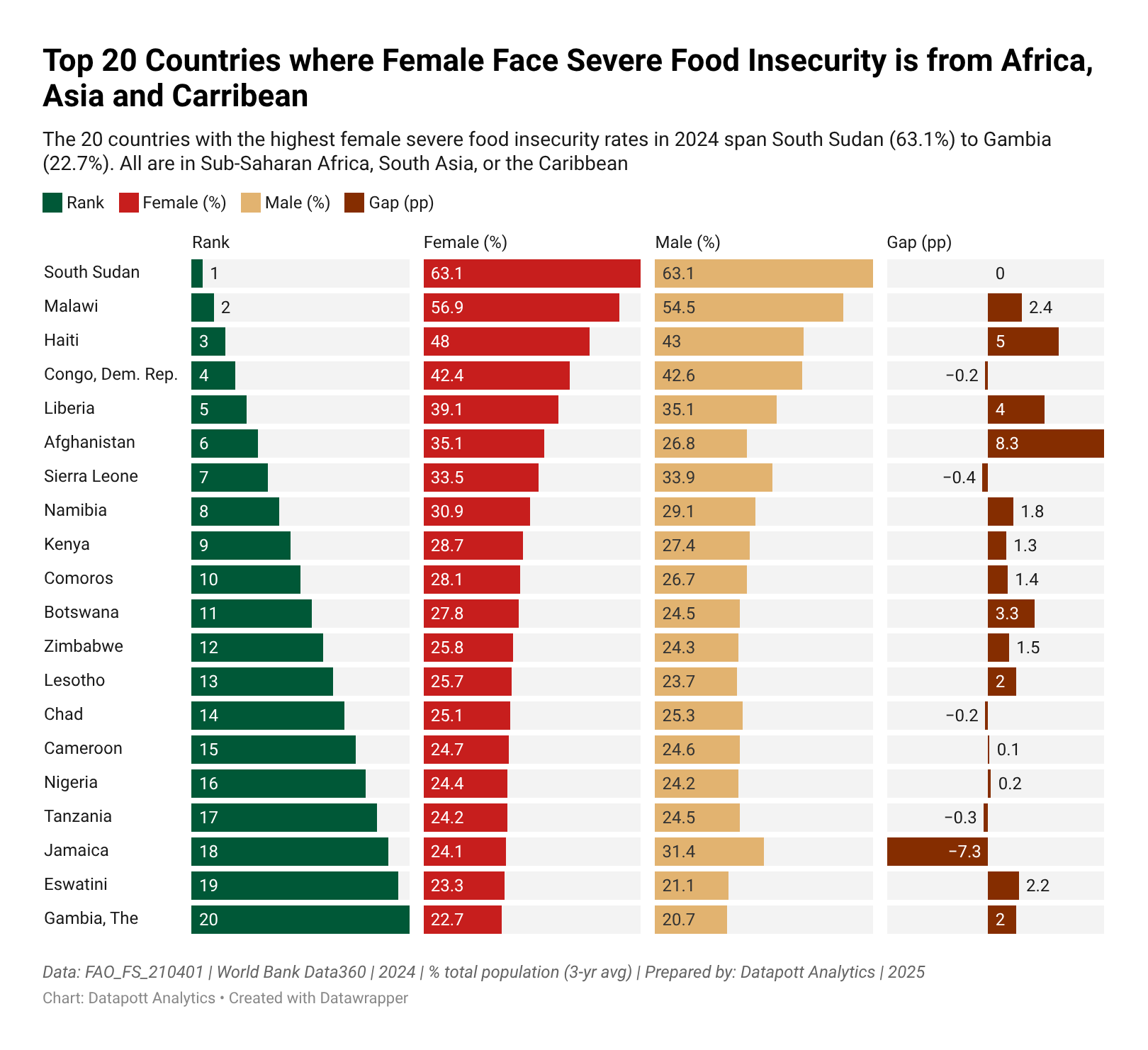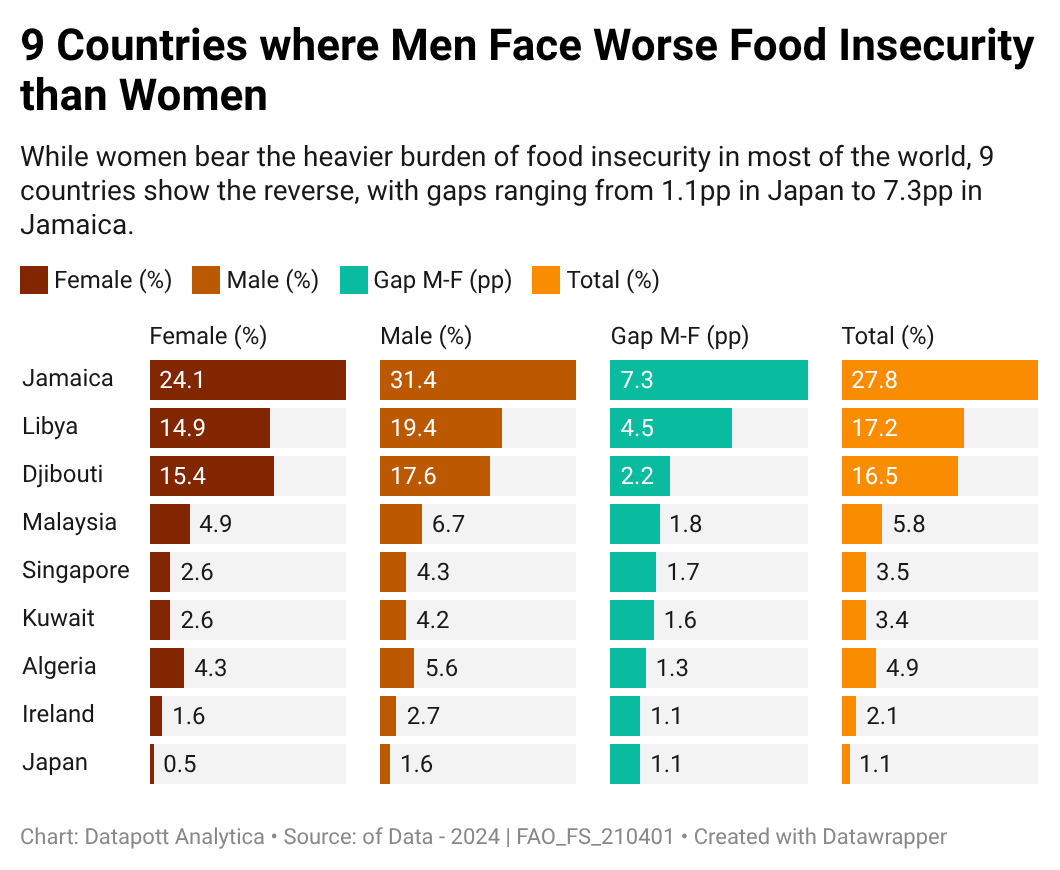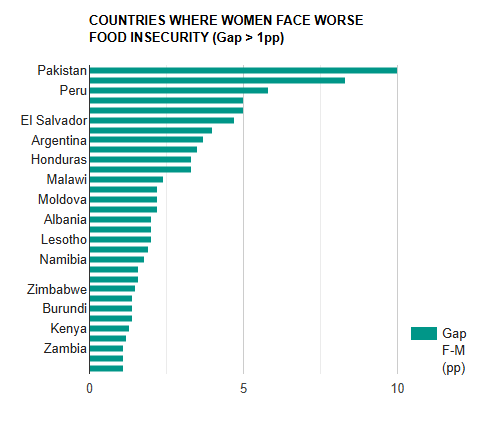
While wealthy nations report rates below 2%, countries like South Sudan (63.1%), Malawi (55.6%), and Haiti (45.4%) face a food emergency measured not in percentages, but in the daily survival of tens of millions.

Analysis Summary:
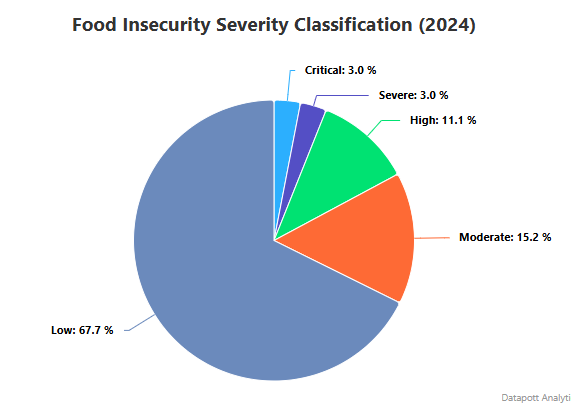
- The global mean severe food insecurity rate rose from 7.8% in 2016 to a peak of 10.7% in 2022 before slightly easing to 10.0% in 2024; with 41 countries still above 10%, including 22 above 20% and 4 in critical crisis above 40%.
- South Sudan (63.1%), Malawi (55.6%), Haiti (45.4%), and DR Congo (42.5%) are in a state of food emergency; where the majority or near-majority of the population cannot reliably access enough food.
- COVID-19 caused a measurable global setback: the mean rate jumped from 9.0% in 2019 to 9.8% in 2020, compounding pre-existing vulnerabilities in the most fragile nations and pushing millions deeper into food insecurity.
- Afghanistan saw the sharpest deterioration of any data-consistent country, rising 2% from 14.8% in 2016 to 31.0% in 2024, driven by conflict, the 2021 Taliban takeover, and collapse of aid systems.
- Zimbabwe achieved the largest improvement – falling 10.4pp from 35.5% to 25.1% – alongside Algeria (-8.1%) and Chad (-7.2%), proving meaningful gains are possible even in structurally vulnerable economies.
Where is is Worse, and Who is Moving in the Right Direction?
The severe food insecurity data tells a story of a world moving in the wrong direction. Between 2016 and 2024, the global mean rate climbed 2.2%; a trend that accelerated sharply during COVID-19 and has not fully recovered. Yet the headline average conceals a far more alarming reality: the crisis is overwhelmingly concentrated in a small number of fragile states, mostly in Sub-Saharan Africa and conflict-affected regions. South Sudan at 63.1%, Malawi at 55.6%, and Haiti at 45.4% are not food-insecure countries, they are countries in active food emergencies where the normal mechanisms of market supply, income, and aid have broken down.
Afghanistan’s 16.2 percentage point deterioration is the single most alarming country-level trend in the dataset. Starting from a position of already significant food insecurity (14.8% in 2016), the country has crossed 30% by 2024, a trajectory driven by decades of conflict culminating in the 2021 political collapse. Nigeria’s +13.3pp rise and Kenya’s +13.1pp increase point to a broader West and East African deterioration that is structurally linked to climate-driven agricultural failures, rising input costs, and currency depreciation reducing food purchasing power.
The success stories, Zimbabwe, Algeria, Chad, Uganda, offer a critical lesson: recovery is possible even from very high baselines, when political stability, agricultural investment, and targeted social support align. Zimbabwe’s 10.4pp improvement from 35.5% to 25.1% demonstrates that structural transformation of food systems can deliver rapid, measurable results.
The question for the international community is whether the political will and financing exist to replicate these gains at scale across the countries still deteriorating.
Policy Recommendations
- Declare a Food Emergency Protocol for Critical-Tier Countries: South Sudan, Malawi, Haiti, and DR Congo require an internationally coordinated emergency food response — not development aid cycles. The UN World Food Programme and FAO must activate emergency protocols with dedicated, ring-fenced funding distinct from general humanitarian budgets.
- Link Peace and Food Security Funding: The data makes unmistakably clear that the countries with the worst and most deteriorating food insecurity are conflict-affected. Afghanistan, Nigeria, Kenya, and Haiti all demonstrate that food insecurity cannot be resolved without addressing the underlying political instability. Development finance must be explicitly conditional on and coordinated with peacebuilding investments.
- Build Climate-Resilient Food Systems in Sub-Saharan Africa: The convergence of high food insecurity rates with climate vulnerability across Sub-Saharan Africa demands a dedicated regional programme for drought-resistant crop varieties, small-scale irrigation, post-harvest storage infrastructure, and weather-indexed crop insurance accessible to smallholder farmers.
- Scale the Zimbabwe-Algeria Model of Rapid Recovery: Countries that achieved double-digit reductions in severe food insecurity share common factors: macroeconomic stabilisation, targeted food price subsidies, and expansion of smallholder agricultural support. A structured South-South knowledge transfer programme should document and disseminate these approaches to the High and Severe tier countries.
- Permanent COVID-Proof Food Safety Nets: The 2019–2020 spike of nearly 1 percentage point in one year demonstrates how quickly food systems collapse under economic shocks. Governments in Moderate and High-tier countries must build automatic, pre-funded food voucher or cash transfer systems that activate immediately when GDP, employment, or food price indices breach defined thresholds.
……………………………………………..
Data: FAO_FS_210401 — Prevalence of Severe Food Insecurity (3-yr avg, % total pop.) | World Bank Data360 | Prepared by: Datapott Analytics | 2026
[wpdatatable id=35]