
Summary:
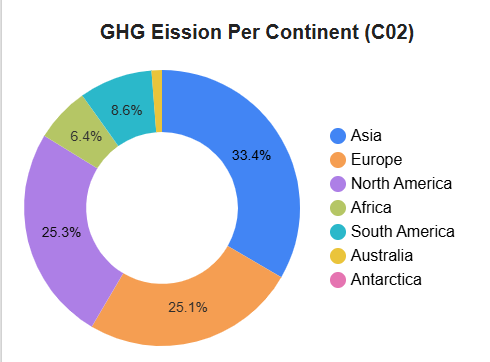
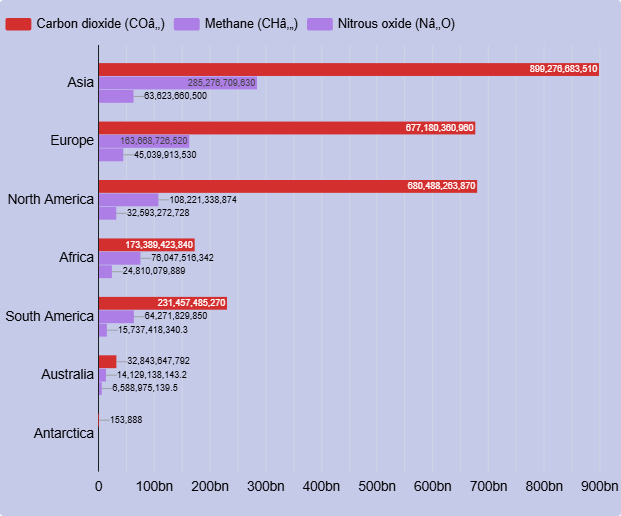
- Asia is the world’s single largest greenhouse gas emitter, responsible for 33.4% of annual CO2 output and a staggering cumulative total of 899 billion tonnes, more than North America (680bn t) and Europe (677bn t) individually.
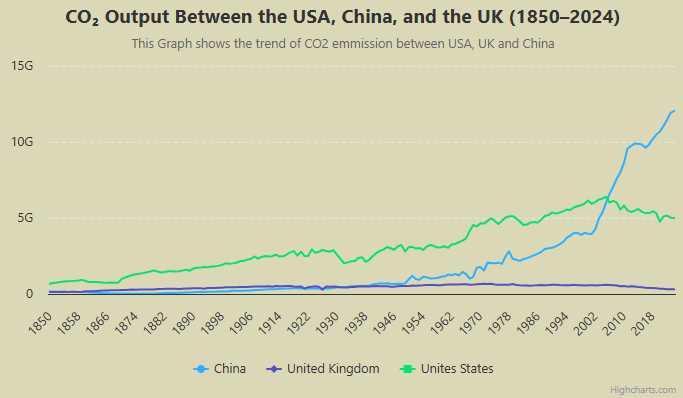
- North America and Europe are nearly tied in cumulative CO2 emissions (~680bn t each), but both show a declining trend since the mid-2000s as Asia’s trajectory surges sharply upward.
- Asia also dominates methane emissions at 285 billion tonnes — 74% more than Europe‘s 163bn t — driven by agriculture, livestock, and fossil fuel extraction across the region.
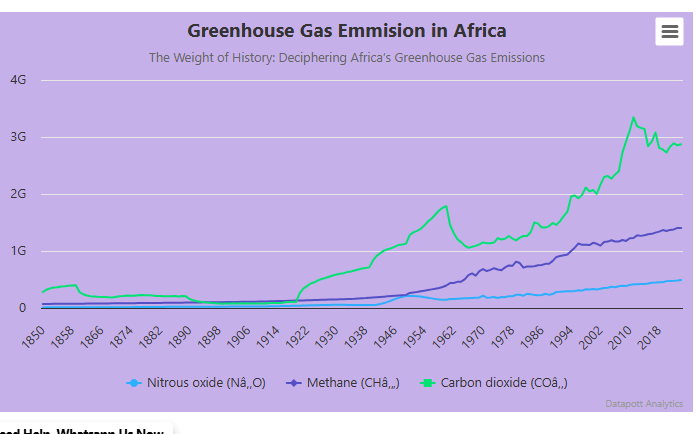
- Africa, despite bearing some of the heaviest consequences of climate change, contributes only 173bn t cumulatively in CO2 and 76bn t in methane — among the lowest of any major continent.
- Australia contributes just 32.8bn t in cumulative CO2 but its per-capita footprint remains among the world’s highest, making it a disproportionate emitter relative to its population
The Emissions Landscape: Who Is Responsible?
The global greenhouse gas data reveals a stark and deeply uneven picture of responsibility. Asia’s dominance is total: 33.4% of annual CO₂, 899 billion tonnes cumulatively, and 285 billion tonnes of methane — the highest figures across every gas category. This is driven by rapid industrialisation, coal dependency, and the sheer population and economic scale of countries like China, India, and Southeast Asian nations. What the trend line makes clear is that Asia’s emissions trajectory has not peaked: while North America and Europe show signs of levelling off or declining post-2005, Asia’s curve continues its sharp upward climb into 2021.
Equally important is what the data reveals about historical responsibility versus current vulnerability. Africa, with only 173bn t of cumulative CO₂ and 76bn t of methane, contributes a fraction of what industrialised nations have emitted over centuries — yet faces disproportionate climate risks through drought, flooding, and food insecurity. This emissions inequity must sit at the centre of any credible climate justice discussion.
The methane and nitrous oxide data adds further urgency. These gases have warming potentials many times greater than CO₂ over short timeframes. Asia’s 285bn t methane output alone makes it a critical target for near-term intervention in agriculture and fossil fuel leakage — sectors where gains can be achieved faster than decarbonising electricity grids.
Policy Recommendations
- Binding Asian Emission Targets: International climate frameworks must set enforceable, time-bound CO2 and methane reduction targets for Asia’s major emitters — particularly China, India, and Southeast Asia — with independent monitoring mechanisms.
- Methane Fast-Track Programme: Given methane’s short atmospheric lifetime and high warming potential, a dedicated Asia-Pacific methane reduction fund should be established targeting agriculture, coal mining, and oil and gas leakage.
- Climate Finance for Africa: Developed nations and high-emitting regions must accelerate climate finance commitments to Africa, recognising its minimal historical emissions and maximum vulnerability to climate impacts.
- Reward Declining Emitters: Europe and North America’s post-2005 downward trajectory should be formally recognised and used as a replicable model — with green technology transfer agreements to accelerate similar transitions in Asia.
- Per-Capita Accountability for Australia: Australia’s low absolute emissions mask one of the world’s highest per-capita footprints. Policy frameworks should incorporate per-capita metrics alongside absolute totals to ensure small-population, high-emission nations are held accountable.