
Summary
- Only 55% of HIV-positive children aged 0–14 are on antiretroviral therapy — the lowest coverage of any demographic group tracked by UNAIDS in 2024.
- The treatment gap for children is 28 percentage points below adult women (83%) — a disparity that represents a systemic failure in paediatric healthcare delivery.
- Roughly 630,000 HIV-positive children have no access to treatment, making them invisible to the health systems that are supposed to protect them.
- 84% of pregnant women living with HIV received PMTCT services — yet children born HIV-positive still face drastically lower odds of receiving lifelong care.
- Without urgent scale-up of paediatric ART, the 2025 UNAIDS target of 34 million on treatment will mask a generation of children left behind.
 ………………………………………………………………………………………………………………….
The data exposes a deeply troubling paradox at the heart of the global HIV response: the world is making progress, but children are being systematically left behind. With only 55% of HIV-positive children aged 0–14 on ART — compared to 83% of adult women — the treatment gap is not a marginal failure. It is a 28-percentage-point chasm that reflects structural neglect of paediatric healthcare in the countries most affected by HIV.
………………………………………………………………………………………………………………….
The data exposes a deeply troubling paradox at the heart of the global HIV response: the world is making progress, but children are being systematically left behind. With only 55% of HIV-positive children aged 0–14 on ART — compared to 83% of adult women — the treatment gap is not a marginal failure. It is a 28-percentage-point chasm that reflects structural neglect of paediatric healthcare in the countries most affected by HIV.
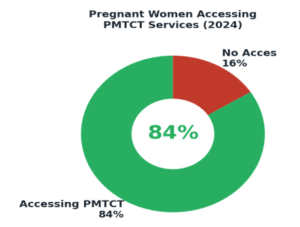 What makes this especially alarming is the prevention paradox: 84% of pregnant women with HIV accessed PMTCT services in 2024, meaning most HIV-positive births are preventable. Yet the children who are born with HIV — or contract it in early life — fall into a care vacuum. They are screened less, diagnosed later, and treated far less consistently than adults. The pipeline from prevention to long-term paediatric treatment is broken.
Closing this gap demands targeted investment in paediatric formulations, community-based testing for children, and caregiver-focused adherence support. Without deliberate, urgent action, the 630,000 children currently untreated will remain the most visible — and most preventable — failure of the global AIDS response.
Data Source: UNAIDS Global HIV & AIDS Statistics Fact Sheet, 2024 | Prepared by: Datapott Analytics | 2025
What makes this especially alarming is the prevention paradox: 84% of pregnant women with HIV accessed PMTCT services in 2024, meaning most HIV-positive births are preventable. Yet the children who are born with HIV — or contract it in early life — fall into a care vacuum. They are screened less, diagnosed later, and treated far less consistently than adults. The pipeline from prevention to long-term paediatric treatment is broken.
Closing this gap demands targeted investment in paediatric formulations, community-based testing for children, and caregiver-focused adherence support. Without deliberate, urgent action, the 630,000 children currently untreated will remain the most visible — and most preventable — failure of the global AIDS response.
Data Source: UNAIDS Global HIV & AIDS Statistics Fact Sheet, 2024 | Prepared by: Datapott Analytics | 2025