[wpdatachart id=5]
Summary
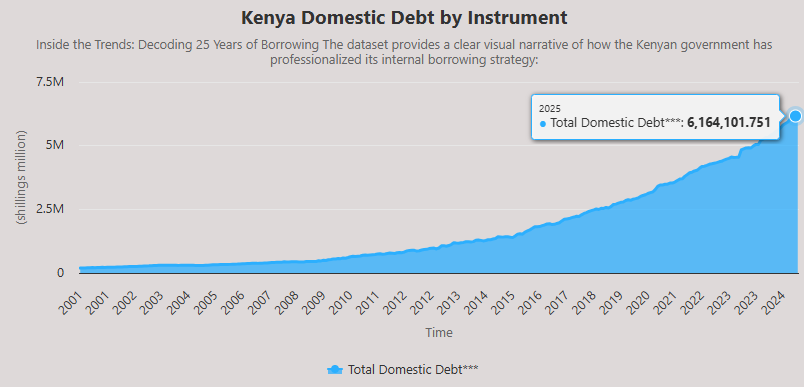
Kenya’s domestic debt landscape has undergone a tectonic shift over the last quarter-century. Data from the Central Bank of Kenya reveals that total domestic debt has surged from approximately Ksh 183.4 billion in 1999 to a staggering Ksh 6.2 trillion by May 2025. This expansion is not just a story of increasing volume but one of structural transformation. Treasury Bonds have evolved from a secondary borrowing tool into the primary backbone of the state’s internal financing, now accounting for over 80% of the total domestic debt portfolio. This article analyzes the transition from short-term bills to long-dated bonds and evaluates what this “maturity lengthening” means for Kenya’s debt sustainability in a high-interest environment.
Inside the Trends: Decoding 25 Years of Borrowing
The dataset provides a clear visual narrative of how the Kenyan government has professionalized its internal borrowing strategy:
- The Great Rebalancing: From Bills to Bonds
In September 1999, the government relied heavily on short-term liquidity. Treasury Bills (Ksh 115 billion) were the dominant instrument, representing nearly four times the volume of Treasury Bonds (Ksh 27.8 billion).
- Inference: By May 2025, the script has flipped. Treasury Bonds have ballooned to Ksh 5.03 trillion, while Treasury Bills stand at Ksh 979 billion. This deliberate shift toward bonds indicates a strategy to reduce “refinancing risk”—the danger of having to pay back large amounts of debt in a very short window.
- The Death of “Government Stocks”
The data shows the gradual phasing out of traditional Government Stocks. In the early 2000s, these accounted for a small but consistent portion of debt (~Ksh 3 billion).
- Inference: By the mid-2020s, these have dropped to zero. The government has modernized its debt instruments, favoring the liquidity and secondary market trading of modern Treasury Bonds over older, static debt instruments.
- The Central Bank Overdraft: The “Last Resort” Buffer
The “Overdraft at Central Bank” column shows significant monthly fluctuations, currently sitting at Ksh 94.9 billion (May 2025).
- Inference: Compared to the trillions in bonds, the overdraft remains a relatively small “emergency valve.” Its continued presence highlights the government’s periodic need for immediate cash flow to meet short-term obligations before taxes or auction proceeds are collected.
[wpdatatable id=19]